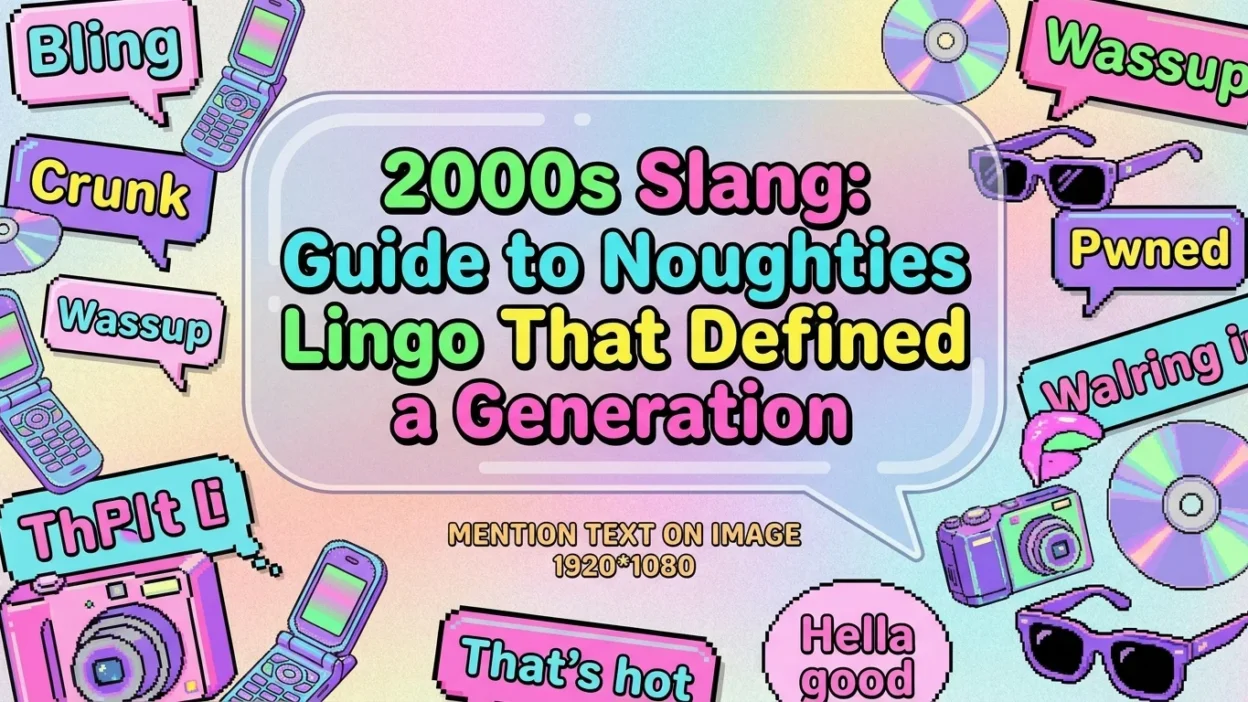
Do you remember when saying “that’s hot” made you sound incredibly cool? Can you recall when “wassup?!” was the only acceptable way to answer your phone? The 2000s might not seem that long ago, yet some of the slang from this era feels like it belongs to an entirely different lifetime. The first decade of the 21st century saw millennials coming of age amidst wars, a major recession, the dawn of social media, and the explosive rise of reality TV. Not surprisingly, the language they created reflected these massive cultural shifts.
2000s slang represents the largest cultural forces at play during the decade, particularly among teenagers who were most likely to invent new words and phrases. From the rise of internet chat rooms to the explosion of hip-hop culture, the noughties gave us a vocabulary that was as colorful as it was ephemeral. This guide takes you back to the days of flip phones, AIM, and frosted tips to decode the lingo that defined a generation.
So grab your low-rise jeans, put down your BlackBerry, and let’s take a trip down memory lane. We’ll revisit the 2000s slang that made us cringe, laugh, and feel oh-so-cool.
H2: The Hip-Hop and Pop Culture Slang That Dominated the 2000s
The 2000s were heavily influenced by hip-hop, R&B, and reality television. The slang of the era often originated in music videos. It then spread to suburban high schools across America through MTV and radio. Let’s explore the most iconic phrases.
H3: Bling Bling
Meaning: flashy jewelry or expensive accessories.
Having “bling” or “bling bling” originated in rap music. Artists competed to show off their wealth with expensive jewelry and cars. The phrase was introduced in the 1999 song “Bling Bling,” featuring artists from Cash Money Records. It blew up throughout the 2000s and became everywhere.
Like a lot of slang invented by Black Americans, it was co-opted by mainstream culture. After peaking in 2007, it has fallen mostly out of use. Today, being “blinged out” often just makes people laugh. It makes them think you’re trying too hard.
H3: That’s Hot
Meaning: that’s good, cool, or sexy.
Every generation has to invent a new way to say something is cool. While “that’s hot” falls in that category, it stands out for a different reason. It was popularized by a single person: Paris Hilton. Heiress to the Hilton Hotels fortune, Paris became one of the first people to be “famous for being famous.”
Her reality show The Simple Life (2003-2007) launched her catchphrase “That’s hot” into the world. Fun fact: Paris literally owns the phrase. She successfully sued companies that used it on products without her permission.
H3: Fo Shizzle, Fo Sheezy, and Skrilla
Snoop Dogg’s influence on 2000s slang cannot be overstated. “Fo shizzle” (for sure) and “fo sheezy” became playful alternatives for agreement. “Skrill” or “skrilla” was slang for money, popularized in hip-hop lyrics. “Flossy” meant to show off or be flashy. These terms were fun to say but have since become dated relics of the early 2000s.
H3: Dime, Boo, and Dawg
The term “dime” was coined by hip-hop artist Nelly. It described someone extremely attractive—a perfect 10. “Boo” became an endearing term for a significant other. It became slang after Usher and Alicia Keys released “My Boo” in 2004. “Dawg” was popularized largely by Randy Jackson. He used the phrase on American Idol to describe friends and acquaintances.
H3: Crunk
“Crunk” was the anthem of clubs and parties everywhere. You’ll also hear it in conversations about Lil Jon tracks.
H2: Internet Slang and the Rise of Digital Communication
The 2000s marked a pivotal shift in how we communicate. The rise of instant messaging, chat rooms, and early social media changed everything. This digital landscape gave birth to a whole new vocabulary designed for speed and efficiency.
H3: BRB, TTYL, and AFK
In the early days of the internet, “brb” (be right back) was everywhere. It was used constantly in chat rooms and on AIM (AOL Instant Messenger). People used it when they had to step away from their computer. They also used it when someone else needed to use the phone line.
However, in 2024, TikTok users noticed that “brb” had disappeared from online conversations. The bittersweet reason? We don’t say “be right back” anymore because “we live here now.” The internet has evolved from “a single, solitary, unmoving place.” It has become “a terror that extends to everywhere.” Most people carry the internet in their pockets at all times.
Other similar phrases like “ttyl” (talk to you later) and “afk” (away from keyboard) have also faded. We’re rarely ever truly offline anymore.
H3: Noob (or n00b)
Meaning: someone who is new or inexperienced at something.
“Noob” (often written in leet speak as “n00b”) is one of the most iconic pieces of 2000s slang from the early internet. It was a shortened version of “newbie.” It became a major characteristic of gamer culture. In the 2000s, it was a way to distinguish internet “old-timers” from new, inexperienced users. Its use has only grown since then, though it’s now applied more broadly outside gaming.
H3: A/S/L (Age/Sex/Location)
When interacting with strangers in chat rooms, the standard opening question was “A/S/L?” This shorthand was used to quickly find out the age, sex, and general location of the person. A 2001 Pew report found that teenagers listed A/S/L as the most common question asked of people entering chat rooms.
H2: Everyday Slang You’d Hear in the Hallways
The 2000s also gave us plenty of casual slang for everyday conversations. These were the words you’d hear in school hallways, at parties, or just hanging out with friends.
H3: Wassup?!
“What’s up?” has been used to ask how people are doing since at least the beginning of the 19th century. But “wassup?!” became a symbol of the 2000s thanks to a Budweiser ad campaign. The commercials, which largely aired during football games, became extremely popular from 1999 to 2002. They were parodied endlessly and became part of the cultural fabric.
H3: Chillax
“Chillax” is a portmanteau of “chill” and “relax”—words that essentially mean the same thing. The doubling up probably just intensified how chilled and relaxed a person was. In the early 2000s, the phrase was associated with people who smoked pot and didn’t work hard. Despite being associated with 2000s slang, its use has actually grown since then.
H3: Sketchy
In the late 1990s, “sketchy” shifted in meaning. It moved from “incomplete” to meaning “strange” or “untrustworthy.” It firmly lodged itself into the youth lexicon in the 2000s. People used it to describe all kinds of people, places, and things that seemed suspicious.
H3: Peeps and Rents
“Peeps” was short for “people” (your friends). “Rents” was short for “parents.” These shortened words captured the casual, efficient vibe of 2000s communication. They were perfect for quick text messages and chat conversations.
H3: Take a Chill Pill
If someone was going “postal” and things weren’t “dope,” you’d tell them to “take a chill pill.” This phrase had mixed origins. Some say it references a pill to reduce fever from the 1800s. Others think it references ADHD medication from the 80s. Either way, it was everywhere in the noughties.
H3: Whatevs and Cray
“Whatevs” was the ultimate shrug. It was the way to say “whatever” with maximum sass. “Cray” was the short version of “crazy” popularized by Kanye West. Both were go-to options for dramatic teens and 20-somethings who wanted to express themselves with minimal effort.
H2: How 2000s Slang Compares to Today
The internet has accelerated the lifecycle of slang dramatically. Terms that once made you sound cool now make you smile, cringe, or reminisce about flip phones and frosted tips.
2000s SlangMeaningModern EquivalentThat’s hotCool, attractiveThat’s fire / That slapsFo shizzleFor sureFor real / No capNoobInexperienced personNewbie (still used)Wassup?!How are you?Sup? / What’s good?BooSignificant otherBae / PartnerCrunkPartying hardLit / Turn upBlingFlashy jewelryDrip / Ice
The shift from “brb” to “I live here now” perfectly captures how much the internet has changed. Similarly, terms like “my bad” (casual apology) and “word” (affirmation) now feel dated. However, they survive in certain contexts and among certain age groups.
Type2000s Slang ExamplesPop Culture InfluencedThat’s hot, Boo, Dawg, Bling blingInternet/Texting LingoBRB, TTYL, AFK, Noob, A/S/LHip-Hop OriginatedFo shizzle, Skrilla, Crunk, DimeCasual ConversationChillax, Sketchy, Whatevs, Cray
H2: The Cultural Significance of 2000s Slang
2000s slang was more than just words. It reflected a generation coming of age during a transformative period in history. The early 2000s saw the rise of social media platforms like MySpace and Friendster. These platforms gave teenagers new ways to express themselves and connect with others.
The slang of this era also reflected economic realities. The term “bling” emerged during a time of conspicuous consumption. The dot-com boom and hip-hop’s mainstream success made wealth display more acceptable than ever before.
H3: Regional Variations in 2000s Slang
While some 2000s slang was national, other terms had regional flavors. In California, “hella” became a defining word of the decade. In the South, “fixin’ to” remained popular. The internet began to homogenize these regional differences, but they still existed.
H3: The Influence of Pop Culture
Reality TV played a huge role in spreading 2000s slang. Shows like The Simple Life, American Idol, and The Osbournes introduced catchphrases to millions of viewers. Music videos on MTV and BET also spread slang rapidly. Rap lyrics became a primary source for new vocabulary.
H3: The Role of Technology
Text messaging and instant messaging shaped how we used 2000s slang. Character limits encouraged abbreviations. The need for speed created shortcuts. SMS culture gave us “lol,” “brb,” and “ttyl.” These abbreviations became part of the mainstream vocabulary.
H2: Slang That Survived Beyond the 2000s
Not all 2000s slang died with the decade. Some terms survived and evolved. Others found new life in different contexts.
H3: “My Bad”
“My bad” originated in the 1970s but gained mainstream popularity in the 2000s. It’s a casual way to apologize for a minor mistake. The phrase has survived and is still commonly used today.
H3: “Chill”
“Chill” became popular in the 1990s but peaked in the 2000s. It can mean to relax, to hang out, or to describe something cool. The word has proven remarkably durable and remains part of everyday vocabulary.
H3: “Hella”
“Hella” originated in Northern California in the 1980s. It became nationally recognized in the 2000s and has continued to spread. It’s now used across the United States, though some regions still find it distinctly West Coast.
Surviving SlangOriginal MeaningCurrent UsageMy badCasual apologyStill commonChillRelax/coolWidely usedHellaVery/reallyRegional but growingPeepsFriends/peopleLess common but knownDopeCool/goodResurgent in 2020s
H2: Slang That Didn’t Survive
Some 2000s slang vanished almost completely. These terms now serve as markers of the decade.
H3: “Werd”
“Werd” was a 2000s alternative to “word.” It meant “I agree” or “that’s true.” The term has largely disappeared from everyday conversation.
H3: “Rad”
“Rad” was a 1980s term that saw a brief revival in the 2000s. It meant “excellent” or “cool.” The revival didn’t last, and the term has returned to its 80s associations.
H3: “Gnarley”
“Gnarley” was borrowed from surfer culture. It meant “extreme” or “cool.” It had a brief moment in the 2000s but has since faded away.
H3: “Stoked”
“Stoked” meant “excited” or “enthusiastic.” It’s still used in surf and skate communities but has largely disappeared from mainstream conversation.
H2: Lessons from 2000s Slang
2000s slang teaches us several important lessons about language and culture.
H3: Language Is Always Changing
Slang is the fastest-changing part of any language. What’s cool today will be cringe tomorrow. This is natural and inevitable. Embracing the change makes language more fun.
H3: Technology Shapes Language
The rise of the internet and mobile phones fundamentally changed how we communicate. 2000s slang reflects that shift. The need for speed created abbreviations. The desire for privacy created codes. These innovations continue to shape how we talk.
H3: Pop Culture Matters
Music, television, and movies spread slang faster than ever before. A single catchphrase from a reality show could become a national phenomenon overnight. This speed of spread is even faster today.
H3: Slang Reflects Values
The terms we use reveal what we care about. In the 2000s, we cared about wealth (bling), appearances (that’s hot), and speed (brb). Today’s slang reflects similar values with different words.
H2: FAQ: Your Questions About 2000s Slang Answered
1. What is the most iconic 2000s slang?
Many consider “bling bling” and “that’s hot” among the most iconic. “Bling bling” originated in hip-hop and became mainstream. “That’s hot” was Paris Hilton’s signature catchphrase that defined the era.
2. Why did “brb” disappear from online conversations?
The phrase “brb” faded because we’re now always online. TikTok users noted that saying “be right back” feels meaningless when we carry the internet in our pockets everywhere we go.
3. What does “crunk” mean?
“Crunk” combines “crazy” and “drunk.” People used it to describe hyped party energy in the early 2000s. It’s heavily associated with hip-hop artists like Lil Jon.
4. What was “A/S/L”?
A/S/L (age/sex/location) was a standard question in chat rooms. People used it to quickly find out basic information about someone they were interacting with online.
5. What does “noob” mean?
“Noob” (often written as “n00b” in leet speak) is a shortened version of “newbie.” It refers to someone who is new or inexperienced at something, especially in gaming.
6. Is any 2000s slang still used today?
Yes, several terms survived. “My bad,” “chill,” and “dope” are still commonly used. “Hella” continues to spread beyond its California origins.
7. Why did 2000s slang change so quickly?
The internet accelerated slang turnover. New terms spread faster than ever before. They also became dated faster as new terms replaced them.
Conclusion
2000s slang represents a unique moment in cultural history. It bridged the pre-internet world and the hyper-connected digital age we live in today. The language of the noughties was shaped by the rise of instant messaging, the dominance of hip-hop, and the birth of reality television. Words like “bling bling,” “crunk,” and “that’s hot” captured the energy of the era. Digital shorthand like “brb,” “ttyl,” and “noob” reflected a new way of communicating.
Revisiting 2000s slang today is like opening a time capsule. Some of these words have vanished entirely. Others have evolved or been reclaimed by new generations. However, the noughties left an indelible mark on how we speak and communicate. They influenced the slang of today in ways we’re still discovering. So whether you’re feeling nostalgic or just learning about this era for the first time, remember—it’s not “cray” to appreciate where our language has been. It’s just “hella” interesting, “fo shizzle.”

Muhammad Arslan is the founder of Namesvora, sharing creative and trending game, team, and username ideas.