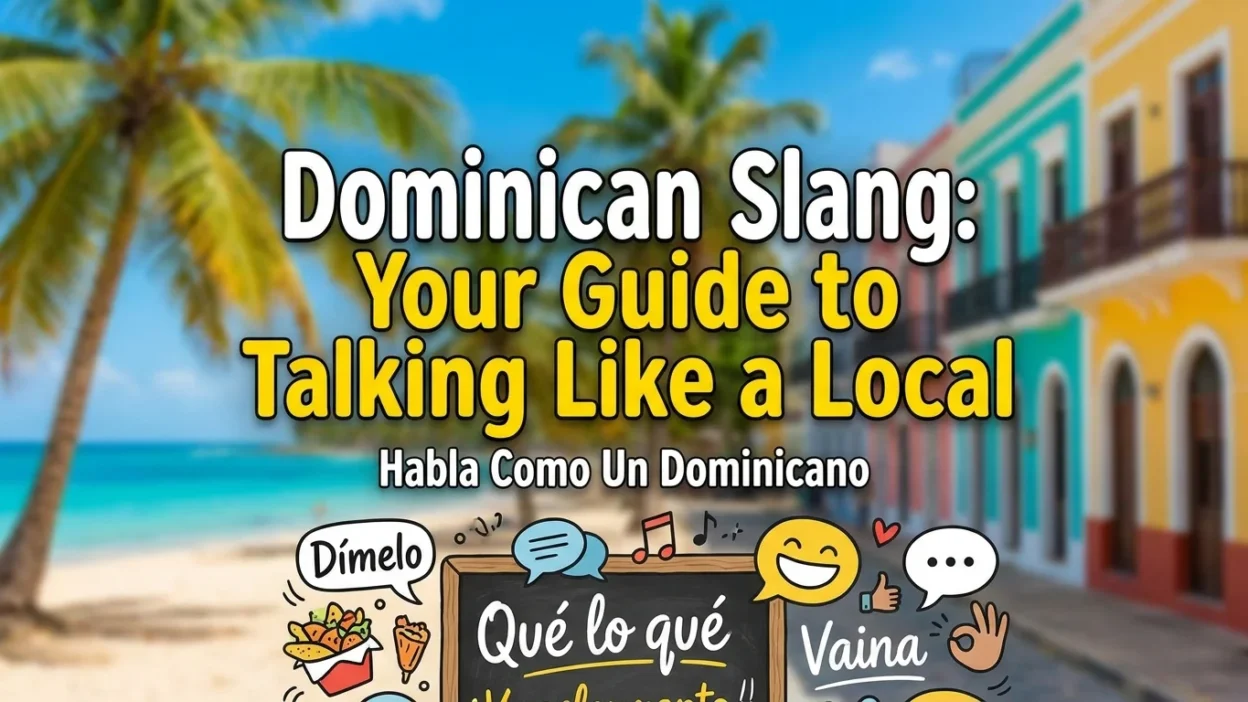
Dominican Spanish is famous for its speed, rhythm, and unique slang. If you want to understand what locals are actually saying, you need to learn the words that don’t appear in standard textbooks.
Dominicans don’t speak textbook Spanish. They speak a vibrant, fast-paced Caribbean dialect full of shortcuts, borrowed words, and creative expressions . The Dominican accent drops S’s and D’s, mashes words together, and swaps R’s for L’s . Once you understand these patterns, the whole language starts to make sense.
H2: What Makes Dominican Spanish Different?
The Dominican Republic has its own unique flavor of Spanish. It’s heavily influenced by African languages, Taino (indigenous Caribbean), and even English. The country even has its own dictionary—the Diccionario del español dominicano—published by the Academia Dominicana de la Lengua .
H3: The Dropped “S”
This is the biggest difference you’ll notice. Dominicans often drop the “S” at the end of words or syllables:
- “¿Cómo estás?” becomes “¿Cómo ‘tá?”
- “Buenos días” becomes “Bueno día”
- “Gracias” becomes “Gracia”
H3: The Dropped “D”
The “D” also disappears, especially in words ending with “-ado”:
- “Cansado” becomes “Cansao”
- “Pescado” becomes “Pescao”
- “Ciudad” becomes “Ciuda”
H3: R Becomes L (in the Cibao Region)
In the northern Cibao valley, you’ll hear this pronunciation shift:
- “Comer” becomes “Comel”
- “Amor” becomes “Amol”
- “Mejor” becomes “Mejol”
H3: Words Mash Together
Dominicans love to shorten phrases by blending them:
- “Voy para allá” becomes “Vo’ p’allá”
- “¿Tú estás bien?” becomes “¿Tá bien?”
H2: The Most Essential Dominican Slang Words
These are the words you’ll hear constantly in the DR.
H3: ¡Vaina!
Vaina is the Swiss Army knife of Dominican Spanish . It can mean just about anything: a thing, a situation, a problem, or stuff .
- “Pásame esa vaina.” — “Hand me that thing.”
- “¡Qué vaina!” — “What a bummer/mess!”
- “La vaina es que…” — “The thing is…”
Note: Vaina is informal. It’s fine with friends, but avoid it in job interviews or formal settings .
H3: ¡Jevi!
Jevi (or jebi) means cool, awesome, or great. It comes from the English word “heavy” .
- “La fiesta está jevi.” — “The party is cool.”
- “Toy jevi.” — “I’m good.”
H3: ¿Qué lo qué?
¿Qué lo qué? is the ultimate Dominican greeting. It means “What’s up?” or “What’s new?” . You’ll hear this constantly.
H3: Tíguere / Tiguere
Tíguere means a street-smart, resourceful person who knows how to handle themselves . It can be a compliment or a warning depending on the context .
- Positive: Someone clever who gets things done.
- Negative: A small-time crook or loudmouth .
H3: Pariguayo
Pariguayo means someone who’s awkward, uncool, or out of their depth . It allegedly comes from “party watcher”—the person who just watches at parties instead of joining in .
H3: Un Chin
Un chin means a little bit or a small amount .
- “Dame un chin de café.” — “Give me a little bit of coffee.”
H2: More Essential Dominican Slang
Here are some other words you’ll hear every day.
SlangMeaningExampleYipetaSUV or truck (from “Jeep”) “¡Qué yipeta tan cara!”GuaguaPublic bus or van “Voy a tomar la guagua.”MotoconchoMotorcycle taxi “Toma un motoconcho.”ColmadoNeighborhood corner store and hangout spot “Voy al colmado.”JumoDrunk or intoxication “Está en un jumo.”ChapearTo show off, especially with money “Está chapeando.”CheleA cent or smallest unit of money “No tengo un chele.”TatoOkay, alright, agreed “¿Nos vemos a las 8?” “Tato.”PanaFriend, buddy “Oye, pana.”
H2: Dominican Greetings and Responses
Instead of “hola,” use these local greetings.
H3: How to Say Hello
- “¿Qué lo qué?” — What’s up?
- “Dime a ver” — Tell me what’s good
- “Dame luz” — Give me the scoop / Fill me in
- “Dímelo” — Tell me / What’s up?
H3: How to Respond Like a Local
Instead of just “estoy bien,” try these:
- “Toy jevi” — I’m good
- “Tranki” — Chill
- “Todo bien” — All good
- “Aquí” — Hanging in there
H2: Dominican Phrases You Need to Know
Here’s how Dominicans say everyday things in their own unique way.
H3: Wait a Minute Isn’t Wait a Minute
In Dominican Spanish, “ahora” doesn’t always mean “now.” It often means “later” . Only “ahora mismo” means “right this second” .
- “Ahora vengo.” — “I’ll be back later.” (Not “I’ll be back now”!)
H3: When You’re Broke
- “Estoy en olla.” — “I’m broke.” (Literally: “I’m in the pan.”)
- “Estoy en mala.” — “I’m having economic problems.”
H3: Other Fun Dominican Expressions
- “Cortar los ojos” — To give someone a dirty look
- “Hacer hora” — To wait
- “Dar un toque” — To call someone on the phone
- “Hacerse el/la loco/a” — To play dumb
H2: FAQs (5 Questions, Answered in 2-3 Lines)
H3: What does “vaina” mean in Dominican Spanish?
“Vaina” is a catch-all word that means thing, stuff, situation, or problem. It’s used constantly in everyday conversation. For example, “Pásame esa vaina” means “Hand me that thing” .
H3: What does “jevi” mean in Dominican slang?
“Jevi” means cool, awesome, or great. It comes from the English word “heavy.” You might hear “La fiesta está jevi” which means “The party is cool” .
H3: What does “tíguere” mean?
“Tíguere” means a street-smart, resourceful person. It can be a compliment about someone’s cleverness or a warning about someone being untrustworthy. Context matters a lot .
H3: Why do Dominicans drop the “S” in words?
Dropping the “S” is a common feature of Caribbean Spanish. Dominicans often aspirate or drop S’s at the end of syllables. For example, “¿Cómo estás?” becomes “¿Cómo ‘tá?” .
H3: What’s the most common Dominican greeting?
The most common greeting is “¿Qué lo qué?” which means “What’s up?” or “What’s new?” You’ll hear it everywhere in the Dominican Republic .
H2: Final Thoughts
Dominican slang is colorful, fast, and full of personality. Learning it isn’t just about vocabulary—it’s about understanding the culture. Words like vaina, jevi, and tíguere carry meanings that standard textbooks can’t capture.
The key to speaking like a local is embracing the rhythm . Drop those S’s. Shorten your words. And don’t be afraid to use slang with friends at the colmado. Dominican Republic is the fastest Spanish you’ll ever hear . But once your ear adjusts? You’ll fall in love with it.

Muhammad Arslan is the founder of Namesvora, sharing creative and trending game, team, and username ideas.