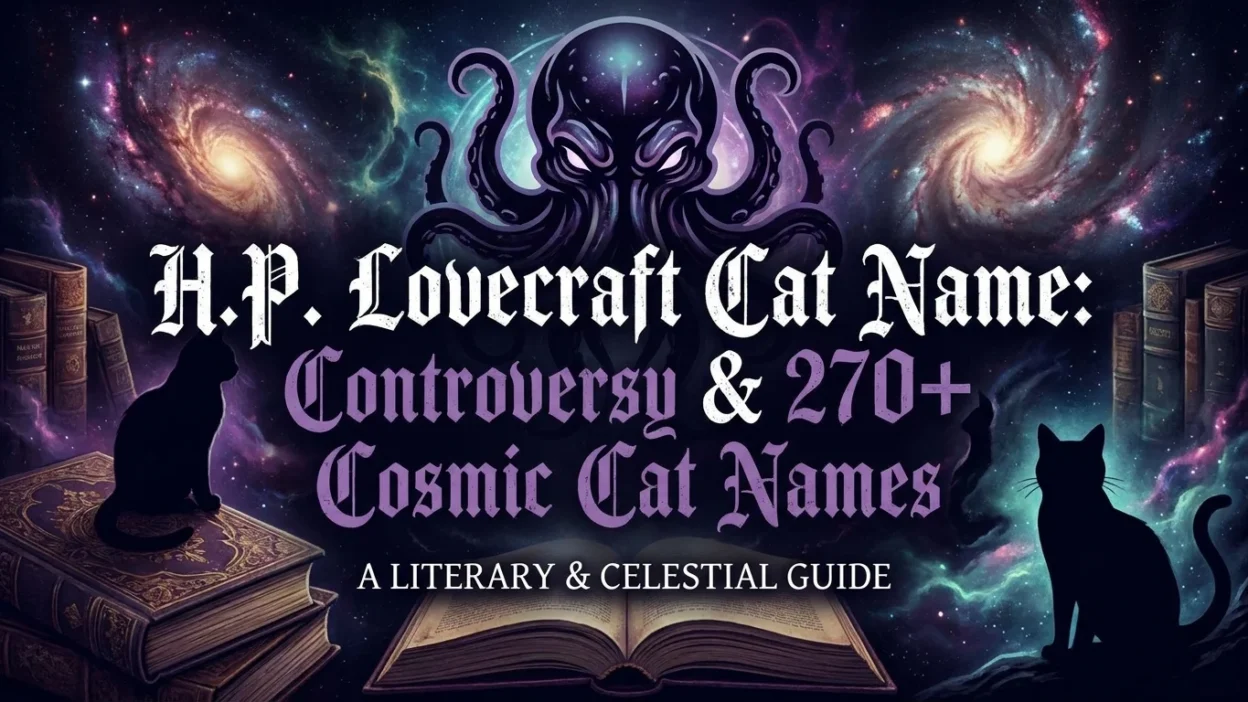
Few topics generate as much shock as the name of hp lovecraft cat name. This topic has become one of the most searched aspects of the author’s personal life. It even eclipses his famous Cthulhu Mythos in some online circles. This small detail about a beloved pet has opened larger conversations. These conversations cover Lovecraft’s racism and the casual bigotry of early 20th-century America. They also explore how we grapple with problematic artists today.
The story of Lovecraft’s cat offers a window into his complexities. Lovecraft wrote some of the most influential horror fiction ever created. Yet he also harbored deeply troubling prejudices. The cat’s name was a racial slur common in Lovecraft’s era. Today we universally condemn such language. This name has sparked countless discussions, memes, and debates across social media. Understanding this story requires examining Lovecraft’s childhood and the era he lived in. It also requires looking at his complicated legacy.
🤔 What Was H.P. Lovecraft’s Cat Name?
The infamous H.P. Lovecraft cat name was Nigger-Man. Yes, you read that correctly. Lovecraft’s family gave this name to a black cat during his childhood. The cat lived with the Lovecraft family in Providence, Rhode Island. It remained a beloved companion until its disappearance in 1904. Lovecraft was about 14 years old at that time.
This name contains a racial epithet. Scholars and fans cite it repeatedly in discussions of Lovecraft’s racial attitudes. Such language was more commonplace in American society during the late 19th and early 20th centuries. That fact does not excuse the name or the racism it represented. The cat’s name has since become a meme. Many online “Don’t Google” challenges invite users to search for it. They often confront the shocking racial slur directly.
👶 The Origin Story of Lovecraft’s Feline Companion
Lovecraft received his famous cat when he was just 5 years old. His parents or other adult relatives gave him the kitten. This detail becomes crucial when discussing who named the animal. Historical accounts show Lovecraft received the cat around 1899. He was about nine years old when the cat entered his life.
The black cat became Lovecraft’s constant companion during his formative years. He grew deeply attached to the feline. This attachment developed into a lifelong love of cats. His love of cats permeated both his personal life and his literary works. This cat was the only pet Lovecraft ever owned. He later befriended many strays in his neighborhood. He showered them with affection and creative names.
👨👩👦 Did Lovecraft Name the Cat Himself?
This question sparks the most debate about the H.P. Lovecraft cat nam. Most evidence suggests Lovecraft did not give the cat its offensive name. He received the cat at age 5. It seems unlikely that a child of that age chose such a name independently. Most historians and biographers agree that Lovecraft’s parents or other adult relatives named the cat.
However, the nuance does not end there. Critics point out that Lovecraft continued to use the name throughout his life. His continued use of the name reflects his personal prejudices. It also shows the racial attitudes he carried throughout his life.
😔 The Racist Context Behind the Name
To understand the H.P. Lovecraft cat name fully, we must examine the racial climate of the era. Lovecraft lived when racism was deeply embedded in American culture. Racial slurs were common. Naming pets, mountains, plants, and even sports teams with such language was disturbingly normalized. Lovecraft’s family participated in this casual bigotry like many white families of their social class.
Lovecraft himself held deeply racist views. These views went well beyond the norms of his time. He feared and distrusted non-WASP groups. These included Irish Catholics, German immigrants, and African-Americans. His personal writings and letters reveal a man who viewed racial purity as paramount. He expressed xenophobic fears about immigration and cultural mixing. His adult writings demonstrate that his racism was not merely a childhood inheritance. It was a deeply held belief system.
❤️ Lovecraft’s Deep Love for Cats
Despite the problematic name, Lovecraft’s genuine affection for his cat is undeniable. He was what we would today call a “cat person” through and through. Cats appear throughout his personal letters, poetry, and fiction. They symbolize mystery, elegance, and otherworldly wisdom. Lovecraft saw cats as superior to dogs. He famously wrote that “the dog is a peasant and the cat is a gentleman.”
Lovecraft’s relationship with his cat was profound and emotional. In letters, he described the cat as “one of the most fascinating & understanding creatures I’ve ever seen.” He praised its intelligence, playfulness, and almost human-like communication. The cat would play ball with him. It would talk in “a genuine language of varied intonations.” It shared his explorations of the night. This deep bond shows that the cat was more than just a pet. It was a true companion and confidant.
🏃♂️ The Cat’s Disappearance in 1904
Tragedy struck in 1904 when Lovecraft’s beloved cat disappeared. The cat either died or ran away. This loss deeply affected the young Lovecraft. He was 14 years old at the time. The disappearance marked a turning point in his relationship with animals. After losing this cherished companion, Lovecraft never owned another pet. This decision suggests the loss was too painful to repeat.
Lovecraft documented the cat’s disappearance in his letters. He reminisced about the feline with fondness and sadness. This loss may have contributed to his lifelong fascination with cats in his writing. Unable to have a living cat companion, he created fictional feline friends. He populated his stories with mysterious, powerful cats. These cats often served as guardians or supernatural allies.
📖 The Rats in the Walls Connection
Lovecraft paid tribute to his childhood cat by giving its name to the feline character in his 1923 short story “The Rats in the Walls.” The story’s narrator, Delapore, owns a beloved black cat with the same name. This is a clear homage to Lovecraft’s lost companion. The cat in the story sleeps at the narrator’s feet. It provides comfort during the terrifying events of the tale.
The story’s inclusion of the cat’s name has been controversial. Later reprints often changed the name to “Blackie” or “Black Tom” to avoid offense. These changes occurred especially in the 1950s when attitudes began to shift. However, the original text remains available in many editions. It continues to spark debate about how modern readers should engage with Lovecraft’s work. The cat’s presence in the story reflects Lovecraft’s genuine affection for his own cat. It is loyal, protective, and ultimately a victim of the narrator’s descent into madness.
🐈 Other Felines in Lovecraft’s Life
Although Lovecraft never owned another cat, he maintained close relationships with strays in his Providence neighborhood. He gave these felines creative names like “Little Sam Perkins” and “Old Man.” This demonstrates his ongoing affection for cats. It also shows his creative flair for naming them.
Lovecraft also developed friendships with other people’s cats. He was particularly fond of Felis, the cat belonging to his friend and correspondent Frank Belknap Long. Photographs show Lovecraft holding Felis. The image has often been mistakenly used to represent Lovecraft with his own cat in memes. Lovecraft even wrote Christmas greetings to Felis. This shows how his love of cats extended beyond his own animals.
🌙 The Cats of Ulthar
Lovecraft’s most famous fictional treatment of cats is “The Cats of Ulthar.” This short story published in 1920. In this tale, cats are depicted as mysterious, almost supernatural beings. They can avenge those who mistreat them. The story is set in the fictional Dreamlands. It features an old couple who kill cats until they provoke the wrath of the felines.
The story reflects Lovecraft’s belief in the power and nobility of cats. In his fictional universe, cats are not just pets. They are beings with their own societies, languages, and even supernatural abilities. This treatment of cats is one of the more positive aspects of Lovecraft’s legacy. It is a testament to his genuine love for felines.
📝 Lovecraft’s Poetry About Cats
Lovecraft wrote several poems dedicated to cats. These reflect his deep affection for felines. Among these are “Sir Thomas Tryout,” “Little Sam Perkins,” “In Memoriam: Oscar Incoul Verelst of Manhattan,” and “The Cats of New York.” These poems celebrate the beauty, grace, and mystery of cats. They are surprisingly tender for a writer known for cosmic horror.
He also wrote poems to specific cats. He wrote at least two “Christmas Greetings” to Felis, his friend’s cat. These verses show a softer, more sentimental side to Lovecraft. This side often gets overlooked in discussions of his more problematic beliefs. For all his racism and xenophobia, Lovecraft’s love of cats was genuine and enduring.
🎭 The Meme Culture Phenomenon
In the age of the internet, the H.P. Lovecraft cat name has taken on a life of its own. What began as an obscure historical footnote became a viral sensation. Social media spawned countless memes, jokes, and “Don’t Google” challenges. The cat’s name is now one of the most searched terms related to Lovecraft. It surpasses even his most famous literary creations in online popularity.
The memeification of Lovecraft’s cat has been both a blessing and a curse for his legacy. On one hand, it has brought attention to Lovecraft’s racism. It has prompted important conversations about how we engage with problematic artists. On the other hand, it has reduced a complex historical figure to a shocking joke. This sometimes trivializes the serious issues of racism that the topic raises.
💬 The Tumblr Post That Started It All
The viral spread of Lovecraft’s cat name traces to a June 12, 2018 Tumblr post. Under a photograph of Lovecraft holding his friend’s cat, a user commented: “lovecraft and his cat n-… nnnnn-… ummm… his cat’s name was uhhhh…” Another user replied, “what was his name,” later adding “oh no.” This simple exchange received over 204,800 likes and reblogs within two years.
The humor of the post came from the contrast between Lovecraft’s dignified image and the shocking, taboo nature of his cat’s name. The exchange went viral because it captured the awkwardness of acknowledging Lovecraft’s racism. It allowed people to still appreciate his contributions to horror fiction. The post’s popularity demonstrates how social media can transform obscure historical facts into shared cultural experiences.
🚫 Don’t Google H.P. Lovecraft’s Cat
The Tumblr post spawned a whole genre of “Don’t Google” memes. These posts invite users to search for Lovecraft’s cat name. They lure them into reading the racial slur for themselves. The implication is that the name is so shocking that it’s best experienced through direct discovery. It is better than having it spelled out.
These memes gained significant popularity in September 2019. “Reverse-psychology Don’t Google memes” became a trend on Reddit and other platforms. The earliest known “Don’t Google” meme about the cat appeared on Reddit’s r/okbuddyretard. It gained over 540 upvotes in six months. The meme’s appeal lies in its taboo nature. It dares users to do something they know they probably shouldn’t.
📰 Know Your Meme Entry
The cat’s place in internet history was cemented when Know Your Meme created a dedicated entry for “H.P. Lovecraft’s Cat.” The entry details the cat’s origins, its use in memes, and the controversy surrounding it. On June 18, 2018, Know Your Meme user “Cold Hard Crash” uploaded a screenshot of the original Tumblr post. It accumulated over 144,600 views in two years.
The Know Your Meme entry has become the definitive source for understanding the cat’s role in internet culture. It documents the various memes, posts, and discussions that have kept the topic alive. The entry also includes important context about Lovecraft’s racism and the cat’s literary connections. This helps to separate fact from fiction.
⚠️ Why This Cat Name Remains Controversial Today
The H.P. Lovecraft cat name remains controversial for several reasons. First and foremost, it’s a racial slur. This word causes genuine harm and offense. Seeing it used casually, even in a historical context, can be triggering for many people. Second, the name represents the casual racism that was pervasive in Lovecraft’s era. It is a reminder of a darker time in American history.
Third, the name has become a flashpoint in debates about engaging with Lovecraft’s work. Some argue we should separate the art from the artist. They say we can enjoy Lovecraft’s fiction while acknowledging his personal flaws. Others contend that Lovecraft’s racism is integral to his worldview. They say we cannot fully separate it from his writing. The cat’s name serves as a tangible symbol of these ongoing debates.
🌌 The Cats of the Dreamlands
In Lovecraft’s fictional Dreamlands, cats are a noble race. They are friendly towards humans and inimical toward the alien Zoogs and Cats from Saturn. The Dream-Quest of Unknown Kadath features sapient cats. They live in the Earth’s Dreamlands and assist the protagonist Randolph Carter on his journey. These literary cats embody Lovecraft’s idealization of feline nature.
The Dreamlands cats represent Lovecraft’s belief that cats possess otherworldly wisdom and nobility. They are not mere animals. They are beings with their own societies, languages, and even magical abilities. Lovecraft saw cats as superior to humans in many ways. They are more honest, more loyal, and more connected to the mysteries of the universe.
🐕 Lovecraft’s Cat Philosophy
Lovecraft famously preferred cats to dogs. He expressed this preference in his essay “Cats and Dogs.” In this work, he argued that the dog is a “peasant” while the cat is a “gentleman.” This reflects his belief that cats possess dignity, independence, and refinement. Dogs lack these qualities. This philosophy was deeply personal. It was shaped by his relationships with his own cat and the strays he befriended.
Lovecraft’s anti-dog sentiments were not merely aesthetic preferences. They were part of his larger worldview. He saw dogs as servile and common. Cats represented the mysterious and aristocratic. This preference was rooted in his class consciousness. It also reflected his admiration for traditional English values. However, it also reflected his genuine emotional connection to cats.
🎩 The Kappa Alpha Tau Fraternity
Lovecraft invented an imaginary fraternity for the stray cats in his neighborhood. He called it the “Kappa Alpha Tau.” The name means “Kompson Ailouron malikun Taxis.” This translates to “Company of the Elegant Cats.” He filled his letters with stories of the antics of these feline members. He treated them as if they were human club members.
This imaginary fraternity demonstrates Lovecraft’s playful side. It shows his deep engagement with cat culture. He didn’t just like cats. He created elaborate fantasies around them. The Kappa Alpha Tau was a creative outlet. It allowed him to express his love of cats. It also let him escape into a fictional world of feline brotherhood.
📬 Lovecraft’s Letters About His Cat
Lovecraft’s letters to friends and family contain touching tributes to his childhood cat. In a letter to Harry O. Fischer on January 10, 1937, he wrote: “What a boy he was! I watched him grow from a tiny black handful to one of the most fascinating & understanding creatures I’ve ever seen. He used to talk in a genuine language of varied intonations — a special tone for every different meaning.”
In another letter to his aunt Annie Gamwell on August 19, 1921, Lovecraft described his cat leaping in and out of shadowy bushes. He also described it looking through a telescope at remote planets. These personal reflections show that Lovecraft’s relationship with his cat was one of the most meaningful of his life. It was a rare source of pure joy in an otherwise troubled existence.
🤝 Ethical Considerations for Lovecraft Fans Today
For modern fans of Lovecraft, the cat’s name presents an ethical dilemma. How do we acknowledge Lovecraft’s racism while still appreciating his contributions to horror fiction? Some choose to separate the art from the artist. They enjoy Lovecraft’s cosmic horror while condemning his personal beliefs. Others argue that Lovecraft’s racism is inseparable from his work. They say it is impossible to enjoy his fiction without acknowledging its problematic aspects.
Many contemporary Lovecraft fans adopt a “warts and all” approach. These writers have moved beyond Lovecraft’s narrow worldview. The cat’s name is a useful starting point for these conversations. It reminds us that the author who created Cthulhu was a man of his time. He had all the prejudices that entailed.
🌟 200+ Cosmic Cat Names Inspired by Lovecraft 🐾
😺 Cthulhu Mythos Names
- Cthulhu 🐙 – The Great Dreamer himself
- Nyarlathotep 🎭 – The Crawling Chaos
- Yog-Sothoth 🔮 – The Key and the Gate
- Shub-Niggurath 🌿 – The Black Goat of the Woods
- Azathoth 🌌 – The Blind Idiot God
- Dagon 🐟 – The Deep One deity
- Hydra 🐍 – The many-headed one
- Hastur 👑 – The King in Yellow
- Tsathoggua 🦥 – The sleepy one
- Yig 🐍 – The Father of Serpents
- R’lyeh 🏛️ – The sunken city
- Miskatonic 📚 – The river and university
- Arkham 🏚️ – The cursed town
- Innsmouth 🐠 – The coastal horror town
- Dunwich 🏡 – The rural horror
- Kingsport 🌊 – The seaside town
- Carcosa 🌙 – The lost city
- Leng ❄️ – The frozen plateau
- Kadath 🏔️ – The mountain of the gods
- Nodens 🌊 – The sea god
- Bastet 🐈⬛ – The Egyptian cat goddess
- Sphinx 🦁 – The guardian creature
🖤 Dark & Mysterious Names
- Shadow 🌑 – For a dark-coated cat
- Midnight 🌃 – Perfect for black felines
- Obsidian 🔮 – As dark and sleek as volcanic glass
- Onyx ⚫ – A beautiful black stone
- Raven 🐦⬛ – Mysterious and intelligent
- Eclipse 🌒 – When the light fades
- Phantom 👻 – Ghostly and elusive
- Spectre 👤 – Invisible and haunting
- Wraith 🌫️ – A ghostly presence
- Shade 🌥️ – Cool and mysterious
- Umbra 🌗 – The darkest shadow
- Nocturne 🎵 – A night-time melody
- Vesper 🌅 – The evening star
- Nox 🌌 – Latin for night
- Tenebris 🌚 – Darkness in Latin
- Abyss 🌀 – Deep and unfathomable
- Vortex 🌪️ – Twisting and powerful
- Chaos 💥 – Unpredictable and wild
- Rune 🪨 – Ancient and magical
- Talisman 🔮 – A magical object
- Amulet 🧿 – Protective charm
- Grimoire 📖 – A book of spells
- Eldritch 👁️ – Strange and unnatural
- Arcane 🌀 – Mysterious and secret
- Occult 🌙 – Hidden knowledge
🌊 Lovecraftian Inspired Names
- Lovecraft 🖋️ – The master himself
- Providence 🏛️ – His beloved city
- Howard 🧔 – His first name
- Phillips 👨🎓 – His middle name
- August 🍂 – His friend August Derleth
- Derleth 📚 – His literary executor
- Carter 🗺️ – Randolph Carter
- Delapore 🏠 – The narrator of Rats
- Pickman 🎨 – The painter of nightmares
- Wilbur 🐐 – From Dunwich Horror
- Lavinia 🌹 – From The Dunwich Horror
- Whateley 👨🌾 – The cursed family
- Marsh 🦪 – The Innsmouth family
- Obed 🐟 – The patriarch
- Zadok 🍻 – The drunk survivor
- Curwen ⚗️ – The warlock
- Ward 💀 – The cursed student
- Upton 🏠 – From The Shunned House
- Rehoboth 🏥 – The healer
- Mather ⛪ – The puritan
- Derby 🎓 – From The Thing on the Doorstep
- Asenath 👩🦰 – The mysterious wife
- Eliot 🎩 – From The Haunter of the Dark
- Blake 📖 – From The Haunter of the Dark
- Dexter 💀 – From The Statement of Randolph Carter
🌙 Dreamlands Names
- Ulthar 🌙 – The city of cats
- Celephaïs 🏰 – The dream city
- Sarnath 🏚️ – The doomed city
- Ooth-Nargai 🏝️ – The pleasant land
- Oriab 🏔️ – The island of dreams
- Zoog 🐿️ – The small furry creatures
- Gugs 🗡️ – The underground giants
- Ghouls 🧟 – The underworld creatures
- Night-gaunts 🌫️ – The silent flyers
- Dholes 🐍 – The slithering horrors
- Kuranes 👑 – The king of dreams
- Pickman 🎨 – The painter from dreams
- Barzai ⛰️ – The wise man of Ulthar
- Nodens 🌊 – The sea god of dreams
- Nyarlathotep 🎭 – The messenger
- Shantak 🦅 – The flying mounts
- Ngranek ⛰️ – The carved mountain
- Hatheg 🏡 – The village
- Nirvan 🏯 – The city of light
- Serannian 🌟 – The floating city
- Ilek-Vad 🏜️ – The valley of dreams
- Thran 🏰 – The castle of dreams
- Zarhu 🌿 – The garden of dreams
- Yath 🏝️ – The island
- Lalar 🌅 – The city of sunset
🎭 Lovecraftian Cat Names by Color
Black Cats ⚫
- Inkwell 🖊️ – Dark as ink
- Void 🕳️ – The empty darkness
- Pitch 🪣 – Pitch black
- Soot 🌫️ – Dark and smoky
- Charcoal 🔥 – Dark and warm
- Jet ✈️ – Sleek and black
- Panther 🐆 – Wild and elegant
- Salem 🧹 – Witchy and mysterious
- Omen 🔮 – A sign of doom
- Jinx 🍀 – Cursed or lucky
- Hex 🧙 – A magic spell
- Coven 🌙 – A gathering of witches
White Cats 🤍
- Moonbeam 🌙 – Soft moonlight
- Snowflake ❄️ – Delicate and unique
- Frost 🧊 – Cold and pristine
- Pearl 💎 – Precious and rare
- Casper 👻 – Friendly and pale
- Ghost 👻 – Pale and haunting
- Alpine 🏔️ – Mountain inspired
- Cloud ☁️ – Soft and white
- Sugar 🍬 – Sweet and white
- Vanilla 🍦 – Classic and smooth
- Alaska 🏔️ – Cold and beautiful
- Winter ❄️ – The coldest season
Gray Cats 🌫️
- Smoke 🌫️ – Mysterious gray
- Shadow 🌑 – Dark and elusive
- Mist 🌁 – Soft and atmospheric
- Ash 🔥 – Cool and grounded
- Steel ⚔️ – Strong and metallic
- Silver ✨ – Shiny and elegant
- Cloud ☁️ – Light and airy
- Granite 🪨 – Solid and tough
- Titanium ⚙️ – Strong and modern
- Mercury ☿ – Fast and mercurial
- Pewter 🥄 – Dark and vintage
- Dusky 🌅 – Dark gray at dusk
Orange Cats 🧡
- Pumpkin 🎃 – Warm and festive
- Ginger 🌺 – Spicy and bright
- Marmalade 🍊 – Sweet and tangy
- Ember 🔥 – Glowing and warm
- Sunburst ☀️ – Radiant and cheerful
- Tiger 🐯 – Wild and striped
- Fireball 🔥 – Energetic and bright
- Apricot 🍑 – Soft and fruity
- Blaze 🔥 – Fierce and bright
- Copper 🪙 – Shiny and warm
- Cinnamon 🌿 – Spicy and sweet
- Rust 🧡 – Earthy and warm
📖 Literary & Mythological Names
- Poe 📖 – The master of horror
- Edgar 🖋️ – The dark poet
- Bram 🧛 – The vampire creator
- Shelley 💀 – The gothic writer
- Stoker 🧛 – The count’s creator
- Dorian 🎨 – The portrait’s subject
- Heathcliff 🌧️ – Wuthering Heights
- Walpole 🏰 – The castle builder
- Radcliffe 🏚️ – The gothic mistress
- Lewis 🧛 – The monk writer
- Mary 🧬 – The mother of Frankenstein
- Victor 🔬 – The scientist of life
- Dracula 🧛 – The vampire lord
- Frankenstein 🧟 – The creature
- Mina 📖 – The brave woman
- Lucius 🦉 – The mysterious
- Octavius 📚 – The scholar
- Benedict 🙏 – The blessed one
- Sheridan 🏰 – The gothic playwright
- Barnabas 🧛 – The vampire
- Quentin 🎭 – The troubled one
- Collinwood 🏚️ – The haunted house
- Daphne 🌿 – The mystery writer
- Roderick 🏚️ – The troubled man
- Madeline 👻 – The buried sister
🌟 Cosmic & Celestial Names
- Orion 🌟 – The hunter
- Sirius ⭐ – The dog star
- Vega 🌟 – The bright star
- Nova 🌟 – The exploding star
- Aurora 🌌 – The northern lights
- Nebula 🌌 – Cosmic clouds
- Galaxy 🌌 – The universe
- Comet ☄️ – The traveler
- Quasar 🔭 – The bright light
- Pulsar 💫 – The pulsing star
- Zenith 🌅 – The highest point
- Sol ☀️ – The sun
- Luna 🌙 – The moon
- Stella ⭐ – The star
- Celeste 🌌 – Heavenly
- Astrid 🌟 – Divine beauty
- Selene 🌙 – Moon goddess
- Helios ☀️ – Sun god
- Eclipse 🌑 – The passing
- Zenith 🌤️ – The top
- Halley ☄️ – The comet
- Europa 🌕 – Jupiter’s moon
- Io 🌕 – Jupiter’s moon
- Callisto 🌕 – Jupiter’s moon
- Ganymede 🌕 – Largest moon
🧙 Magical & Mystical Names
- Merlin 🧙 – The wizard
- Morgana 🌙 – The enchantress
- Merlin 🧙 – The wise one
- Gandalf 🧙 – The grey wizard
- Saruman 🧙 – The white wizard
- Dumbledore 🧙 – The headmaster
- McGonagall 🧙 – The cat animagus
- Sabrina 🧙 – The teenage witch
- Hermione 📖 – The bookworm
- Luna 🌙 – The dreamy one
- Wanda 🧙 – The magic user
- Agatha 🧙 – The magic collector
- Houdini 🎩 – The escape artist
- Blofeld 🐱 – The villain’s cat
- Binx 🐈⬛ – The cursed cat
- Crookshanks 🐱 – The ginger cat
- Salem 🧹 – The talking cat
- Pyewacket 🐱 – The witch’s familiar
- Grimalkin 🐱 – Ancient word for cat
- Kiki 🔮 – The witch’s companion
- Jiji 🐱 – The black cat friend
- Wednesday 🌙 – The dark day
- Ravenclaw 🦅 – The clever house
- Phoenix 🔥 – The reborn bird
- Gryphon 🦁 – The majestic beast
🏮 Vintage & Old World Names
- Augustus 👑 – The majestic one
- Bartholomew 📖 – The scholar
- Cornelius 🎩 – The gentleman
- Theodore 🧔 – The gifted one
- Nathaniel 🕊️ – The gift of God
- Beauregard 🌿 – The handsome one
- Alistair 🎩 – The defender
- Constantine ⚜️ – The constant one
- Mortimer ⚰️ – The dead one
- Barnabas 🧛 – The son of comfort
- Reginald 👑 – The kingly one
- Percival ⚔️ – The knight
- Llewellyn 🏴 – The lion
- Phineas 🔬 – The oracle
- Septimus ⚱️ – The seventh son
- Algernon 🎭 – The bearded one
- Montague 🏰 – The pointed hill
- Fitzgerald 🎩 – The great one
- Hemingway 📖 – The literary legend
- Fitzgerald 🥃 – The roaring twenties
- Marlowe 📖 – The playwright
- Shakespeare 🎭 – The bard
- Dickens 📚 – The storyteller
- Bronte 📖 – The literary family
- Rossetti 🌹 – The poet
🌿 Nature & Elemental Names
- Fern 🌿 – Delicate and green
- Willow 🌳 – Graceful and strong
- Hazel 🌰 – Warm and earthy
- Ivy 🌿 – Climbing and resilient
- Moss 🌿 – Soft and green
- Cedar 🌲 – Strong and aromatic
- Ash 🌳 – Wise and enduring
- Oak 🪵 – Strong and ancient
- Maple 🍁 – Sweet and colorful
- Birch 🌳 – Beautiful and white
- Pine 🌲 – Fresh and forested
- Slate 🪨 – Dark and smooth
- Clay 🧱 – Moldable and earthy
- Flint 🔥 – Hard and sparky
- Quartz 💎 – Clear and shining
- Jasper 🪨 – Beautiful and protective
- Onyx ⚫ – Protective and dark
- Amber 🧡 – Warm and fossilized
- Coral 🪸 – Oceanic and bright
- Pearl 💎 – Pure and cherished
- Jade 💚 – Green and precious
- Ruby ❤️ – Deep red and valuable
- Sapphire 💙 – Blue and rare
- Topaz 🧡 – Golden and warm
- Emerald 💚 – Green and magical
🎶 Musical & Artsy Names
- Sonata 🎵 – Musical piece
- Melody 🎶 – Sweet sound
- Harmony 🎵 – Peaceful music
- Lyric 🎵 – Poetic words
- Jazz 🎷 – Cool and spontaneous
- Blues 🎸 – Deep and soulful
- Rhythm 🥁 – The beat of life
- Tempo ⏱️ – The speed of life
- Forte 🎵 – Strong and loud
- Piano 🎹 – Soft and gentle
- Crescendo 🔊 – Growing sound
- Aria 🎵 – Operatic song
- Cadence 🎵 – Rhythmic flow
- Coda 🎵 – The closing section
- Rhapsody 🎵 – Passionate music
- Serenade 🌙 – Evening music
- Ballad 📖 – Story song
- Sonnet 📝 – Poetic form
- Haiku 📝 – Brief poetry
- Limerick ☘️ – Playful verse
- Lyrical 📖 – Poetic language
- Staccato 🎵 – Sharp and disconnected
- Legato 🎵 – Smooth and connected
- Vibrato 🎵 – Wavering sound
- Sforzando 🎵 – Sudden loudness
🔮 Esoteric & Occult Names
- Merlin 🧙 – The wizard
- Tarot 🃏 – Mystical cards
- Rune 🪨 – Ancient symbol
- Omen 🔮 – A sign
- Oracle 🔮 – A prophecy
- Aura 👼 – An energy field
- Chakra 🔵 – Energy center
- Karma 🔄 – The cycle
- Dharma ☸️ – Righteousness
- Mantra 🪼 – Sacred sound
- Akasha 🌌 – The cosmic library
- Kether 👑 – The crown
- Binah 🧠 – Understanding
- Chesed ❤️ – Love and compassion
- Geburah 💪 – Severity
- Tiphareth 🌟 – Beauty
- Netzach 🌿 – Eternity
- Hod 🌟 – Splendor
- Yesod 🌙 – Foundation
- Malkuth 👑 – The kingdom
- Daath 📖 – Knowledge
- Ain 👁️ – The void
- Tetragrammaton ✡️ – The four letters
- Shekinah ✨ – Divine presence
- Metatron 👼 – The recording angel
🧠 Conclusion: The Complex Legacy of Lovecraft’s Cat
The story of H.P. Lovecraft’s cat reflects the larger debates surrounding the author. It reveals his deep capacity for love and companionship. It also exposes his problematic views on race. The story highlights the ongoing challenge of engaging with his work in a modern context. The cat’s name has become a symbol. It is a shorthand for Lovecraft’s racism that we cannot ignore or excuse.
Ultimately, the H.P. Lovecraft cat name reminds us that our cultural heroes are complex figures. They reflect both the best and worst of their times. Lovecraft loved his feline companions deeply. Both truths exist simultaneously. We must acknowledge both.
❓ Frequently Asked Questions About H.P. Lovecraft’s Cat
🐈⬛ What was the actual name of H.P. Lovecraft’s cat?
The H.P. Lovecraft cat name was Nigger-Man. This was the name of a black cat owned by Lovecraft’s family during his childhood. The name has been cited frequently in discussions of Lovecraft’s racial attitudes. It remains highly controversial today.
👦 Did Lovecraft name his cat himself?
Most evidence suggests Lovecraft did not name the cat. He received the cat at age 5. His parents or other adult relatives likely named it. However, Lovecraft continued to use the name throughout his life. This included in his adult writings.
📖 In which Lovecraft story does the cat appear?
Lovecraft paid tribute to his cat by giving its name to the feline character in his 1923 short story “The Rats in the Walls.” The narrator owns a cat with the same name. Later reprints often changed the name to “Blackie” or “Black Tom” to avoid offense.
🏠 When did Lovecraft’s cat disappear?
The cat disappeared in 1904 when Lovecraft was about 14 years old. It either died or ran away. This loss deeply affected Lovecraft. He never owned another pet after this experience.
🔍 Why is Lovecraft’s cat name so controversial?
The H.P. Lovecraft cat name is controversial because it contains a racial slur. The name has become a symbol of Lovecraft’s racism. It is a flashpoint in debates about how to engage with his work. Its casual use in online memes has also sparked controversy.
🎭 How did Lovecraft’s cat become a meme?
The cat became a meme through a viral Tumblr post in June 2018. A user commented under a photograph of Lovecraft holding a cat. They struggled to say the cat’s name. This post spawned “Don’t Google” memes and numerous online discussions about Lovecraft’s racism.
🖊️ What did Lovecraft write about his cat?
In his letters, Lovecraft described his cat as “one of the most fascinating & understanding creatures I’ve ever seen.” He praised the cat’s intelligence, playfulness, and communication skills. These letters reveal his genuine love for his feline companion.
💭 Can we separate Lovecraft’s art from his racism?
This remains a matter of debate. Some fans argue we can enjoy Lovecraft’s cosmic horror fiction while condemning his personal beliefs. Others contend his racism is inseparable from his work. They say we must acknowledge it. The cat’s name is often cited as an example. It shows why we cannot simply ignore Lovecraft’s problematic views.

Muhammad Arslan is the founder of Namesvora, sharing creative and trending game, team, and username ideas.