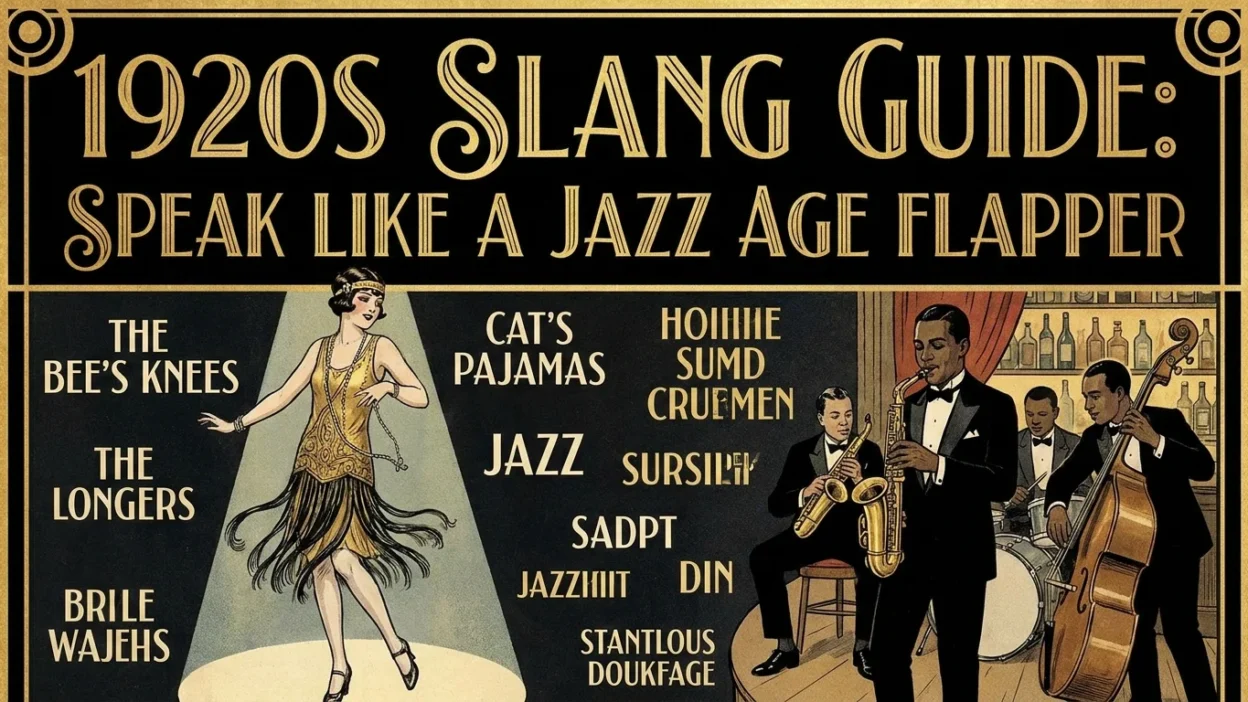
The 1920s were a time of huge change. Women got the vote. Prohibition made alcohol illegal (but that didn’t stop anyone). Jazz music took over. And young people—especially flappers—decided they wanted nothing to do with their parents’ stuffy Victorian ways.
So they invented their own language. It was playful, rebellious, and full of nonsense phrases that sounded cool for no real reason. Think “cat’s pajamas” and “bee’s knees.” None of it made literal sense. But that was the point.
H2: What Made 1920s Slang So Special?
The Jazz Age was the first decade to really celebrate youth culture. Young people had money. They had cars. They had freedom. And they wanted to sound different from their parents.
A lot of 1920s slang came from:
- Flapper culture – These rebellious young women coined tons of new words
- Jazz music – Musicians and fans developed their own lingo
- Prohibition – People needed code words for alcohol and speakeasies
- Movies and cars – New tech brought new vocabulary
The result? A wild mix of playful compliments, clever insults, and secret code words.
H2: Top 1920s Compliments
If you wanted to say something was really good in the 1920s, you didn’t just say “great.” You got creative.
H3: The Bee’s Knees / The Cat’s Pajamas / The Cat’s Meow
These all mean the same thing: the absolute best, most excellent thing ever.
Why cats in pajamas? Nobody really knows. But it was part of a whole trend of nonsense phrases that meant “awesome.” Other variations included “the eel’s ankle” and “the monkey’s eyebrows” (which thankfully didn’t catch on).
Example: “That new jazz band? They’re the bee’s knees, I tell ya!”
H3: Berries
Short, sweet, and to the point. “Berries” meant something attractive or pleasing.
Example: “This speakeasy is the berries!”
H3: Hotsy-Totsy
This one meant excellent, first-rate, or attractive. You could use it for a person or a situation.
Example: “Everything’s hotsy-totsy with my new fella.”
H3: Darb
A person with money who can be relied on to pay the check. Basically, the friend you always want to invite out.
Example: “Don’t worry about the bill—he’s a real darb.”
H3: Air-Tight
This meant super attractive. A compliment for someone who looked really good.
Example: “That flapper over there? Absolutely air-tight.”
H2: Classic 1920s Insults
The 1920s had some absolutely brutal (and creative) ways to insult people.
H3: Dewdropper
A lazy young guy who sleeps all day and doesn’t have a job. They don’t “dew” anything at all.
Example: “My brother’s a total dewdropper. He didn’t get up till noon!”
H3: Egg / Bad Egg
An obnoxious person. A really bad one was a “double-yolker.” But you could also call someone a “good egg” if they were nice.
Example: “Stay away from that guy—he’s a rotten egg.”
H3: Cake-Eater
A player who samples too many sweets (meaning: a guy who dates too many women).
Example: “He’s a total cake-eater. Can’t stay with one girl.”
H3: Bluenose
An excessively puritanical person, a prude, or a buzzkill. Someone who ruins the fun.
Example: “Don’t invite her—she’s such a bluenose.”
H3: Wet Blanket
Another term for a person who spoils everyone’s fun. Same vibe as “bluenose.”
Example: “He’s a wet blanket at every party.”
H3: Flat Tire
A boring or disappointing date. The opposite of the “bee’s knees.”
Example: “Last night’s blind date? Total flat tire.”
H2: 1920s Slang for Dating and Romance
Young people in the 1920s were very into dating. And they had the slang to prove it.
H3: Alarm Clock
This wasn’t something that woke you up. It meant a chaperone who ruined romantic moments.
Example: “Her mom’s coming along? Ugh, alarm clock alert.”
H3: Cash or Check?
A flirty question meaning “should we kiss now, or later?”. “Cash” meant now. “Check” meant later.
Example: “We’re alone in the car. Cash or check?”
H3: Bank’s Closed
A way to say no kissing or making out allowed.
Example: “Sorry, Mac. Bank’s closed tonight.”
H3: Petting Party
A party devoted to hugging, kissing, and caressing. This was a huge deal in the 1920s—and plenty of people disapproved.
Example: “We’re going to a petting party after the dance.”
H3: Blind Date
Going out with someone you’ve never met before. This phrase actually started as college slang in the early 1920s.
Example: “I’ve got a blind date tonight. Wish me luck!”
H3: Carry a Torch
To have a crush on someone.
Example: “She’s still carrying a torch for that guy.”
H3: Struggle Buggy
The backseat of a car—popular for romantic activities.
Example: “Let’s take the struggle buggy for a spin.”
H2: 1920s Slang for Getting Drunk
Prohibition made alcohol illegal. So people got creative with how they talked about it.
H3: Giggle Water / Giggle Juice
Booze, especially champagne, whiskey, and gin. Women especially used this term.
Example: “Pour me some of that giggle water!”
H3: Juice Joint
A speakeasy or illegal nightclub.
Example: “Let’s hit up the juice joint on 52nd Street.”
H3: On a Toot
Going on a drinking spree.
Example: “He’s been on a toot since Friday night.”
H3: Zozzled / Ossified / Spifflicated
All mean extremely drunk. “Zozzled” comes from the older word “sozzled.” “Ossified” is funny because it means “turning to bone.”
Example: “After three cocktails, he was completely zozzled.”
H3: Hooch
Another word for illegal liquor.
Example: “Where’d you get that hooch?”
H3: I Have to See a Man About a Dog
A code phrase meaning you’re going to buy some alcohol.
Example: “Excuse me, I have to see a man about a dog.”
H2: 1920s Slang for Money
Everyone wanted dough in the 1920s. Here’s how they talked about it.
H3: Dough
Money. Still used today!
Example: “I need some dough for the weekend.”
H3: Clam
A dollar.
Example: “Lend me a few clams, will ya?”
H3: Lettuce
Folding money. Because it’s green, you see.
Example: “He’s got plenty of lettuce.”
H3: Mazuma
Cash. This one sounds funny and has Yiddish roots.
Example: “I need some mazuma for the new dress.”
H3: Kale
Money. Same vibe as “dough.”
Example: “She’s rolling in kale.”
H3: Jack
Also money.
Example: “I’m low on jack this week.”
H2: Everyday 1920s Slang
These were the words you’d hear in normal conversation.
H3: Applesauce
Nonsense! An exclamation like “horsefeathers.”
Example: “You expect me to believe that? Applesauce!”
H3: And How
I strongly agree!
Example: “This party’s amazing.” “And how!”
H3: Copacetic
Wonderful, fine, all right. Still used today!
Example: “Everything’s copacetic between us.”
H3: Know Your Onions
To be knowledgeable about a subject. First recorded in a 1922 issue of Harper’s Bazaar.
Example: “She really knows her onions when it comes to jazz.”
H3: Don’t Take Any Wooden Nickels
Don’t do anything stupid. A fun way to say “be careful.”
Example: “I’m heading out now. Don’t take any wooden nickels!”
H3: Tell It to Sweeney
I don’t believe you. Tell your story to someone gullible.
Example: “You won the lottery? Tell it to Sweeney.”
H3: Let’s Blouse
Let’s get out of here. Similar to “let’s blow this joint.”
Example: “This place is dead. Let’s blouse.”
H3: Noodle Juice
Tea. Noodle meant “head,” so noodle juice was “head drink.”
Example: “I’ll have a cup of noodle juice, please.”
H3: Iron Your Shoelaces
Excuse yourself to the bathroom.
Example: “I need to go iron my shoelaces.”
H3: Phonus Balonus
Complete nonsense. Similar to “baloney.”
Example: “That excuse is pure phonus balonus.”
H2: The Flapper Dictionary: Words from 1922
A real “Flappers’ Dictionary” was published in July 1922. Here are some gems from that list:
SlangMeaningAlarm ClockChaperoneBerriesGreatCellar SmellerSomeone who always finds free liquorClotheslineA gossip who tells neighborhood secretsDingle DanglerSomeone who insists on telephoningDimboxA taxicabEdisonedBeing asked a lot of questionsEye OpenerA marriageFather TimeAny man over 30Fire AlarmDivorced womanFire BellMarried womanHoudiniTo be on time for a dateLemon SqueezerAn elevatorTomatoA young woman shy of brainsTrotzkyOld lady with a mustacheUmbrellaA young man any girl can borrow for the evening
H2: Wrapping It Up
H3: What’s Your Favorite 1920s Slang?
It’s hard to pick just one. “Cat’s pajamas” is a classic. “Zozzled” is just fun to say. And “cash or check?” deserves a comeback in the dating world.
H3: Why We Still Love 1920s Slang
The Jazz Age slang was playful. It was rebellious. It celebrated youth, freedom, and having a good time. And honestly? That’s exactly the energy we could use right now.
So next time something’s really good, don’t just say “great.” Say it’s the bee’s knees. And if your friend’s being a buzzkill, call them a bluenose. Who knows? Maybe you’ll start a trend.
Because as they said in the 1920s: “Attaboy!”
H2: FAQs (4 Questions, Answered in 2-3 Lines)
H3: What does “bee’s knees” mean in 1920s slang?
It means something or someone is the best, most excellent thing around. It was part of a trend of nonsense phrases that meant “awesome.”
H3: What did “giggle water” mean in the 1920s?
It meant alcohol—especially champagne, whiskey, or gin. People used code words like this because Prohibition made drinking illegal.
H3: What did “flapper” mean in the 1920s?
A flapper was a fashionable young woman who rebelled against traditional behavior. She wore short skirts, bobbed hair, and enjoyed jazz and parties.
H3: What did “cash or check?” mean in 1920s slang?
It was a flirty question meaning “should we kiss now, or later?” “Cash” meant now. “Check” meant later.
H2: Final Thoughts (Conclusion)
The 1920s gave us some of the most creative, colorful, and straight-up fun slang in American history. It was a decade of rebellion, freedom, and jazz—and the language reflected all of that.
What makes 1920s slang so special is its playfulness. People didn’t just say things were “good.” They made up ridiculous phrases like “the cat’s pajamas” and “the bee’s knees.” They turned insults into art forms (“dewdropper,” anyone?). And they created secret code words for everything from alcohol to romance.
Today, we can still learn from that energy. Slang doesn’t have to make literal sense. It just has to be fun. So next time you’re at a party, try dropping a “copacetic” or a “giggle water.” You might get some weird looks. But you might also start a conversation.
Because the Jazz Age taught us something important: language is meant to be played with. So go ahead. Have some fun with it.
And as they said back then: “The bee’s knees, old sport.” 🎷✨

Muhammad Arslan is the founder of Namesvora, sharing creative and trending game, team, and username ideas.